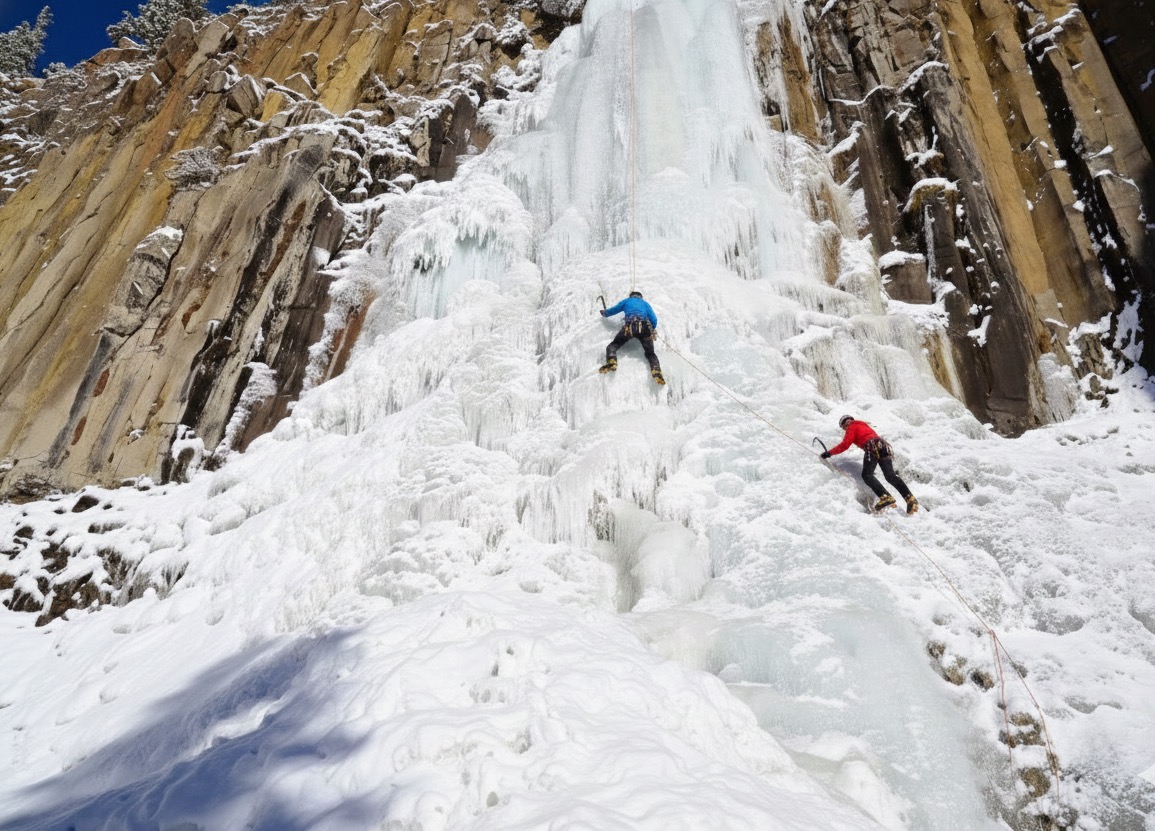
Bozeman’s winter reputation is built on skiing. But the people who really know will tell you about the ice. Hyalite Canyon, about 19 miles south of downtown Bozeman, has over 150 natural ice climbing routes packed into less than 3 square miles. That makes it the most concentrated natural ice climbing venue in North America. National Geographic named it one of the 100 Best American Adventures. Legendary Himalayan climbers like Conrad Anker and Alex Lowe trained here. And in February, the ice is at its best: thick, reliable, and glowing that deep translucent blue that makes the whole canyon feel like another planet.

I haven’t climbed the ice myself yet, but I’ve watched from the base of Palisade Falls while climbers worked their way up a 150-foot frozen curtain, and it made me want to sign up for a course on the spot. This guide is for anyone in the same position: you’ve seen the photos, you’re curious, and you want to know how to actually do this without dying or going broke.
Why February Is the Month
By February, Hyalite’s ice has had months to build. The flows are fat, the pillars are formed, and the conditions are as stable as they get. Earlier in the season, the ice can be thin or inconsistent. Later in the spring, things start to melt and get unpredictable. February is the sweet spot.
The road into the canyon is plowed and maintained thanks to Friends of Hyalite, a nonprofit that raises about $13,000 a year to keep the canyon accessible all winter. Without them, the road would be gated at the bottom and none of this would be “roadside” climbing. If you use the canyon in winter, consider making a donation. Plowing happens on county weekdays only, so after a big storm, give it a day before heading up.
Don’t Go Alone
Ice climbing has a steep safety curve. This is not a “watch a YouTube video and figure it out” activity. The gear is specialized, the environment is unforgiving, and the consequences of a mistake are real. If you’re a beginner, hire a guide. Full stop.
Two guide services operate in Hyalite with proper permits:
Montana Alpine Guides (MAG) has been running trips since 1985. They offer a two-day Intro to Ice Climbing course in Hyalite that covers everything from crampon technique to ice screw placement. They also partner with RMI Guides for intro programs.
Montana Mountaineering Association offers guided ice climbing days and a progression program if you want to keep building skills over time.
Both services provide all the technical gear: boots, crampons, ice axes, helmets, harnesses, and ropes. You show up in warm layers, and they handle the rest. That’s the real advantage of going guided. You don’t need to spend $2,000 on gear you’ve never used to find out if you love it.
The Top-Rope Reality
Here’s something that surprises most people: beginners don’t lead-climb. When you hire a guide, they hike up to the top of the climb, build an anchor, and set a rope. You clip in at the bottom and climb up on that rope, which is always above you, always catching you if you slip. This is called top-roping, and it’s the same concept used in every rock climbing gym in the country. The difference is that instead of plastic holds on a wall, you’re swinging ice axes into a frozen waterfall 30 minutes from Bozeman. Same safety system, completely different experience.
Three Beginner-Friendly Waterfalls
Not all ice is created equal. Here are three routes where guides regularly take first-timers.
Mummy I (WI2, 60 feet)
If there’s a single “first day of ice climbing” route in Hyalite, it’s Mummy I. Rated WI2 (Water Ice Grade 2, meaning roughly 60-degree ice with good footholds), it’s the easiest graded technical ice climb in the canyon. The ice is thick, the base area is spacious enough for multiple groups, and the approach from the Grotto Falls trailhead takes about 20 minutes on foot. Guides love it because you can set two or three top ropes side by side and keep people climbing all day. It’s not flashy, but it’s where you learn to trust your crampons.
Genesis I (WI3, 60 feet)
This is the most popular route in all of Hyalite, and for good reason. It’s a 10-15 minute hike from the Grotto Falls parking lot, and the left line gets so much traffic that previous climbers have kicked steps and pick holes into the ice, effectively making it easier to follow. WI3 means steeper ice (around 70 degrees with some bulges), so it’s a step up from Mummy I, but it’s still very manageable on a top rope with a guide. Genesis I was first climbed on Halloween in 1971, making it one of the earliest ice routes established in North America.
Palisade Falls (WI3-4, 150 feet)
This is the showstopper. The hike to Palisade is short, only about a mile, but the transition is incredible. One minute you’re walking through a silent, snow-heavy forest of lodgepole pines, and the next, the air changes. You’ll likely hear the climbers before you see them: the rhythmic, sharp thwack-thwack of ice axes and the metallic clink of carabiners echoing off the basalt columns long before the waterfall comes into view.

When you finally round the last bend, the scale hits you. Palisade doesn’t just look like a frozen waterfall. It looks like a cathedral of blue organ pipes. In February, the ice takes on this deep, translucent cobalt color that glows when the sun hits the top of the canyon. Even if you aren’t climbing, standing at the base and watching someone tiny move up that massive, shimmering curtain of ice makes you realize why people travel across the world to get here. It’s a quiet, high-stakes dance that makes the “Instagram-worthy” view feel secondary to the actual energy of the place.


Important note: Palisade Falls is on the East Fork road, and that gate closes on January 1. After that, you have to ski or snowshoe from the East Fork parking lot to reach it. Check hyalite.org for current gate status. For beginners who just want to climb, Mummy I and Genesis I are accessed from the main road, which stays plowed all winter. But if you’re up for the extra effort, Palisade is worth every step.
Ice Climbing Grades, Quick and Dirty
You’ll see routes described with “WI” grades. Here’s what they mean in plain English:
- WI2: Entry-level technical climbing. About 60 degrees. You can stand in a balanced position while you figure out your next move. This is where you start.
- WI3: Proper ice climbing. Around 70 degrees with steeper bulges. You need both axes and solid crampon footwork. Most guided beginner experiences happen here.
- WI4: Sustained steep ice, close to vertical in places. Strong beginners can top-rope WI4, but it’s a significant jump in difficulty and endurance.
- WI5 and above: Expert territory. Long vertical ice, thin formations, serious consequences. Not for this guide.
The Logistics

The Road
Hyalite Canyon Road starts about 7 miles south of Bozeman off South 19th Avenue. From there, it’s another 12 miles to the Grotto Falls trailhead at the end of the road. Budget about 30 minutes from town in normal conditions, longer after fresh snow.
Hyalite is not a theme park. It’s a high-alpine wilderness that wants to freeze your radiator and your feet. If you show up in sneakers, you won’t just be cold, you’ll be dangerous to yourself and the people who have to help you when you slip. This road is an icy, winding ribbon of “nope” for anyone without 4WD or AWD and actual winter tires. Even with a 4WD truck, I’ve wished I had chains on my tires because of how slick it can get. With no cell service, you don’t want to get into a sticky situation.
Zero Cell Service
This is a dead zone. The second you turn off 19th Avenue, “googling it” is not an option when you’re stuck. Download offline maps before you leave town (OnX Backcountry and Gaia GPS both work great), and tell someone exactly where you’re going and when you’ll be back. This is not optional.
Gear Rentals
If you’re going with a guide, they’ll provide the climbing-specific gear. But if you’re renting on your own or need winter boots and accessories, two spots in Bozeman can set you up:
Genesis Gear rents ice climbing and mountaineering gear and will deliver it anywhere in the Gallatin Valley. That’s a nice perk if you’re staying at a hotel or rental and don’t want to hunt down a shop.
Uphill Pursuits has a shop in the Cannery District and specializes in human-powered adventure gear. Good people, good selection.
What to Bring
Your guide will tell you exactly what to wear, but the basics: multiple warm layers (wool or synthetic, not cotton), a shell jacket, insulated gloves or mitts you can afford to get wet, warm hat, sunglasses, sunscreen (yes, in February, the snow reflection will burn you), water, and snacks.
The Bottom Line
Ice climbing in Hyalite is one of those experiences that sounds extreme but is genuinely accessible if you do it right. Hire a guide, let them handle the technical stuff, and you’ll be swinging ice axes on a frozen waterfall within an hour of leaving Bozeman. It’s one of the most unique things you can do in Montana in the winter, and Hyalite is one of the best places in the world to try it.
And because there is zero cell service the second you turn off 19th Avenue, treat the canyon like the wild cathedral it is. Buy the microspikes, rent the AWD, tell someone your plan, and it’ll be the best day of your trip.