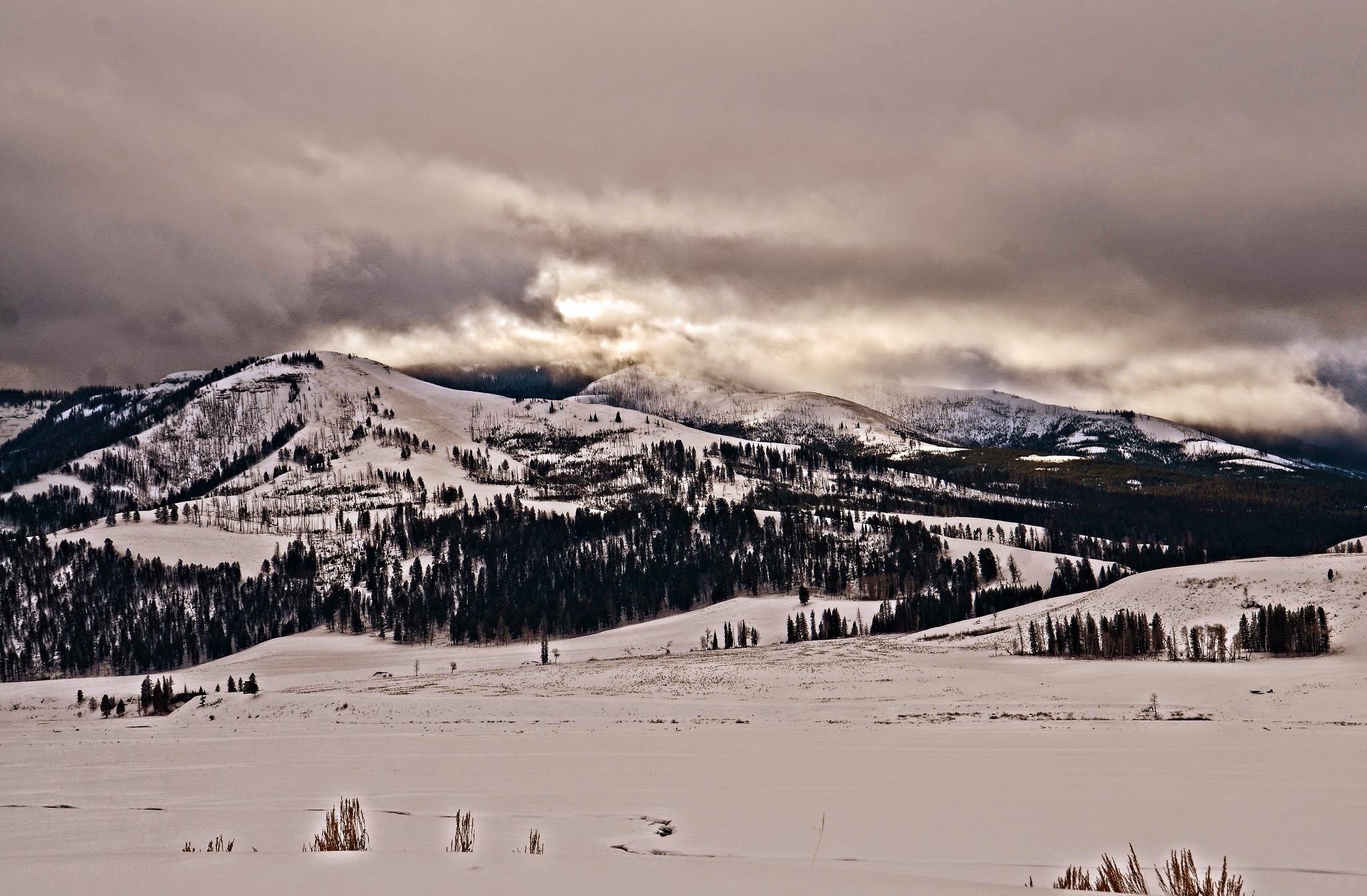
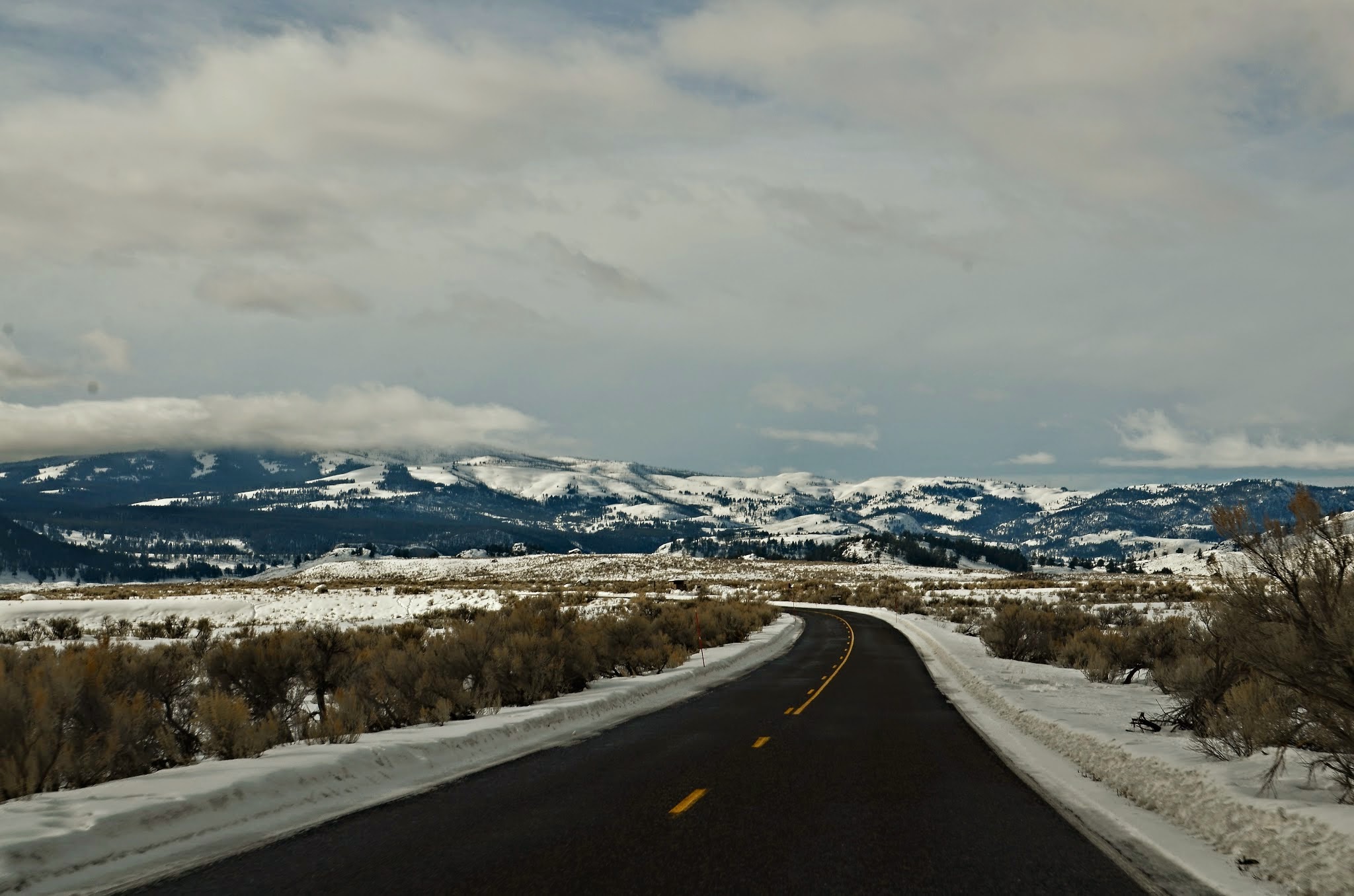
Yellowstone’s official winter season starts shutting down in early March. The snowcoach operators are booking their final tours. The guided snowmobile outfitters are posting their last-call windows. But the road from Mammoth Hot Springs to Cooke City via the Northern Range stays open to private vehicles year-round, and right now it is at its absolute peak.
Because of the 2026 snow drought, the driving is easy and the wildlife is packed into the valley bottoms in numbers that are rare even by Lamar Valley standards. This is a genuinely short window. Here is what you need to know before you drive it this weekend.


The Drive
The route is straightforward. You enter through the Roosevelt Arch in Gardiner, Montana, pay the park entrance fee ($35 per vehicle, valid for seven days), and drive 52 miles northeast along US-212 through the Northern Range to Cooke City. The road passes Mammoth Hot Springs, climbs through the Yellowstone River canyon, and opens onto the massive sagebrush flats of the Lamar Valley before ending at Cooke City, the last real outpost on the route. The Beartooth Highway continuing east is closed for winter, so Cooke City is the turnaround point.
Plan on three to four hours one way if you stop to watch wildlife, which you will.
The 2026 Road Reality
Forget the horror stories of white-knuckle winter driving. Right now the road through the Northern Range is largely bare pavement. Your standard front-wheel-drive sedan will do just fine on the main stretch.

Do not let the dry asphalt make you complacent. The stretch just past Slough Creek still features a steep drop-off to the right with zero guardrails. Morning temperatures regularly dip below freezing and the shaded canyon sections hold black ice well into mid-morning. You are also going to be stopping frequently, which means sitting on a narrow two-lane road while the vehicle behind you has no idea why you braked. Use your hazard lights. Pull fully into a designated pull-out before stopping.
The Road Belongs to Them
The wildlife checklists are accurate. You will see bison. You will see coyotes. With the right timing you will see wolves. But there is something about the actual experience of this drive in late February that no trip report quite gets on the page.
You will creep along at 15 mph while a trio of thick-coated coyotes jogs casually toward your windshield in the oncoming lane, treating Highway 212 like a paved sidewalk they have always owned.

You will come around a blind bend to find a herd of bison standing perfectly still on the center line, their massive shoulders dusted with thin snowy capes, completely uninterested in yielding right-of-way. You turn off your engine. The silence that follows is something. No wind. No traffic. Just a thousand-pound animal staring through your windshield until it decides it is done with you.

Then a park snowplow comes around the corner with its air horn going, trying to scatter a stubborn moose off the pavement, and the whole spell breaks at once.
Or you hear it before you see it: bighorn rams butting heads on the cliffs above the road, a crack like a high-caliber rifle shot echoing down into the valley. That one gets your attention fast.


The Wildlife Is Boxed In
The lack of deep snow at lower elevations this year means the animals have not had to work as hard for food, but they are still concentrated in the valley bottoms, which is exactly where you can see them from the road.


The contrast advantage is real right now. A gray or black wolf stands out against the remaining snowdrifts in a way it simply does not in a year when the ground is mostly brown. Eagles, ravens, and coyotes cluster around winter-kill carcasses and you can watch the whole sequence play out from a pull-out.
Which brings up the Carcass Lottery.
If you see a cluster of cars pulled over with a forest of spotting scopes pointed at the same hillside, pull over safely and walk over. These are people who drive out before sunrise multiple days a week. They know where every pack is sleeping, which elk has been favoring its left leg, and approximately when the Junction Butte wolves last made a kill. They will share what they know generously, and if there is something worth seeing, they will wave you over for a look through the lens without you having to ask. The scope crowd is part of the culture out here. Embrace it.

Be There Before the Sun Is
If you roll through the Roosevelt Arch at 9 AM, you are too late. Predators are most active at first light and with the mild weather this year they are bedding down earlier in the morning to conserve energy. You want to be parked at a pull-out in the heart of the Lamar Valley before the sun crests the Absaroka Range to the east.

That means leaving Bozeman by 3:30 AM or staying in Gardiner the night before. The Absaroka Lodge and a handful of smaller properties stay open through the shoulder season. Gardiner is not a luxury destination but it is functional, and you can fill up on gas and coffee before you drive in.
What Every Guide Undersells: The Solitude
Every Lamar Valley post you will find online is a wildlife checklist. Wolves, bison, done. What none of them quite convey is what the valley is like in late February with almost no one in it.

Summer in the Lamar Valley means pull-outs stuffed with cars, rental RVs idling in the road, and a general sense that everyone is rushing to check wildlife off a list. Late February means you will have entire pull-outs to yourself. You will stop on the road with nothing behind you. You will hear the river. You can watch a herd of elk for twenty minutes without feeling like you need to move for anyone.
If your only frame of reference for Yellowstone is a July trip, this is a different park entirely.
The Zero Amenities Reality
Once you leave Gardiner, you are on your own for the entire drive.
There is no cell service between Mammoth and Cooke City. Download your offline maps before you leave town, let someone know your route and expected return time, and do not count on being able to call for help if something goes sideways.
There are no gas stations between Mammoth and Cooke City. Fill up in Gardiner. Cooke City has a couple of small stations, but it is the end of the line.


Pack like you might get stuck behind a bison jam for two hours, because you might. A thermos of hot coffee, actual snacks, a foam pad to stand on while you look through binoculars (frozen asphalt is brutal on feet after thirty minutes), and an extra insulating layer for wind are all non-negotiable.
What Recent Trail Reports Are Saying
Lamar River Trail is the main access point on the valley floor and the most useful for boots-on-the-ground conditions. Current reports describe the sagebrush flats as frozen and firm, which is actually good news. In a wetter year this section turns into a muddy slog. If you park and walk a mile or two out, be prepared for knee-deep snowdrifts in the shaded ravines even when the open flats look clear.
Slough Creek Trail at the western edge of the valley is the main wolf-watching hotspot. Reviews on sites like AllTrails regularly include timestamps on recent pack activity and carcass locations, which is genuinely useful pre-trip reading.
Trout Lake is a short, steep 0.6-mile hike on the eastern side of the valley, good for stretching your legs after two hours in the car. Current reports say the climb is icy and you need microspikes for the first half mile. Worth doing if you have them with you.
Before You Go
Entry fee: $35 per vehicle, valid for seven days. The $80 America the Beautiful annual pass covers it and pays for itself quickly if you plan to visit Yellowstone more than once this year.
Road conditions: Check the NPS road status page before you leave. Conditions can change overnight.
Timing: Be at your first pull-out before sunrise. The drive from Gardiner to the heart of Lamar Valley is about 45 minutes.
Gas: Fill up in Gardiner. Last chance.
Cell service: None between Mammoth and Cooke City.
What to bring:
- Hot drinks in a thermos
- Snacks for a long wait
- Foam pad or small camp chair for standing on frozen pavement
- Microspikes if you plan to hike Trout Lake
- Binoculars at minimum (a spotting scope is ideal, but binoculars work)
- Layers, and more layers than you think you need for standing in the wind
The official guided season is ending. The road is not. Go before it fills back up.